
By Michela Conte
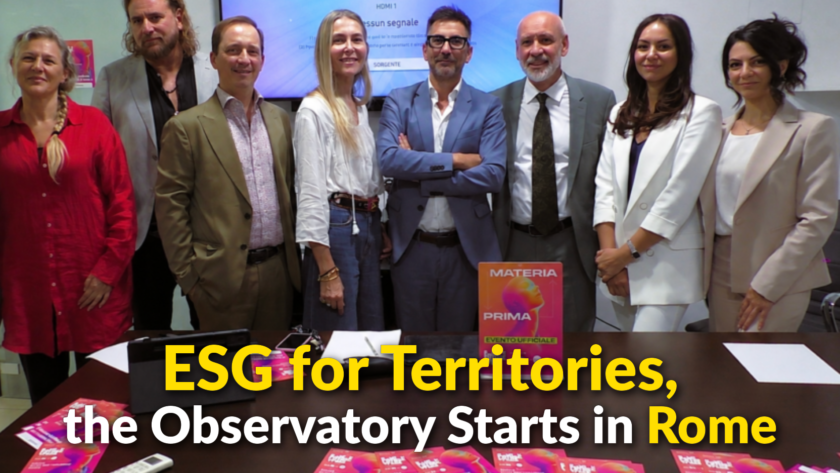
The sustainability of a territory can be measured through data, organisational behaviour, the quality of governance, inclusion, regenerative capacity and impact on communities. This is the idea behind the launch in Rome of the ESG Observatory for Territories, during Rome Future Week, with a conference dedicated to territorial ESG, Benefit Corporations, KPIs and impact.
ESG stands for Environmental, Social and Governance and identifies the three environmental, social and governance dimensions of organisations. Applying these criteria to territories means looking beyond the boundaries of individual companies and connecting businesses, public administrations, universities, communities, services, employment, the environment and quality of life.
The meeting held on 26 September marked the launch of the ESG Observatory for Territories, promoted by Next EU as a permanent research, analysis and monitoring structure focused on territorial sustainability and on developing indicators capable of tracking local transformations.
Sponziello opens the session and presents the Observatory
The event was opened by Marco Sponziello, professor at the University of Salento, Director of the ESG Observatory for Territories and European Climate Pact Ambassador, who introduced the project and the research programme that has been launched.
“The Observatory was created to develop an interpretation of territorial sustainability based on ESG principles, initially applied to companies and then adapted to other public and private organisations operating within territories. When applied at territorial level, these criteria can help us understand how the environment, inclusion, employment, services, education, administrative capacity, governance and participation change over time,” said the Director of the Observatory.
He also emphasised the inaugural nature of the event.
“The Rome meeting represents the starting point of a programme designed to involve academic expertise, businesses, professionals, associations and public administrations,” Sponziello concluded before giving the floor to Salvatore Rizzello, Vice-Rector of the University of Salento, member of the Observatory with responsibility for Higher Education and Full Professor of Political Economy.
Rizzello and individual choices
Professor Rizzello focused on the relationship between regulation, voluntary behaviour and sustainability.
The issue directly concerns the role of legal obligations and the extent to which the ESG transition should be determined by legislation, as opposed to leaving room for individual and collective choices.
Rizzello proposed an interpretation that starts with the individual.
“Before being consumers, individuals are people who develop preferences, values and criteria for making choices. Purchasing therefore becomes a behaviour capable of influencing the market. Companies perceived as consistent from an environmental and social perspective can be rewarded through people’s everyday decisions,” Rizzello concluded.
This dynamic shifts part of sustainability beyond compliance alone and towards culture, reputation and trust.
Rossi and value across generations
Cinzia Rossi, President of Fondazione Communia and Professor of Organisational Anthropology at the Pontifical University Antonianum, addressed the issue of common goods and the lifespan of organisations.
“A company, foundation or institution,” she explained, “may have a lifespan far longer than that of the people who are responsible for it at a particular moment. This perspective changes the way organisational decisions are understood. ESG governance therefore takes on both an intragenerational and intergenerational dimension. Decisions taken today affect people living in the same historical period and may also transfer consequences to future generations.”
Common goods, territories, natural resources, knowledge and social capital therefore become part of the assessment of the value generated by organisations.
Marchionne and the human dimension of the Social pillar of ESG
Pierre Marchionne, Artistic Director of the Italia Green Film Festival, opened his contribution with the screening of a short film about the end of the world. It was a way of shifting the discussion, for a few minutes, from numbers to people.
Marchionne focused his remarks on the S in ESG, the Social dimension concerning people, relationships, culture, inclusion and communities.
The experience of the Italia Green Film Festival, now in its seventh edition, shows how cinema and cultural languages can contribute to increasing awareness of environmental and social issues.
Marchionne also announced a new step in the initiative.
He stated that the next edition of the festival, to be held in Sardinia, will present a manifesto dedicated to territorial ESG, open to organisations willing to share principles and commitments related to territorial sustainability.
Prattichizzo and the value of communicating data
Giovanni Prattichizzo, Social Media Manager and Digital PR at the Italian National Institute of Statistics, ISTAT, brought the issue of data and data communication into the discussion.
The availability of an indicator represents only one part of the work. Statistical data becomes useful when it is explained, contextualised and made understandable to the people who will use it.
The experience gained through ISTAT’s social media communication provides a direct view of this process. Technically accurate figures can have limited impact when the language used makes them feel disconnected from everyday life.
For an Observatory focused on territorial ESG, this issue is particularly relevant. Measurement matters. Explaining what an indicator measures and why that figure matters to citizens, public administrators and businesses is equally important.
Mariano brings gender equality into territorial ESG
Milena Mariano, an advocate and communicator on gender equality, legality and inclusion, focused her contribution on gender equality.
The issue is often addressed within companies through organisational policies, certifications, monitoring systems and indicators. Mariano proposed extending this approach to public administrations and to the measurement of territories.
The presence of women in decision-making positions, access to employment, employment gaps, work-life balance and local policies can become indicators of the Social component of territorial ESG.
Gender equality therefore becomes a variable through which the social quality of a territory can be assessed in concrete terms.
Castelli and the role of Benefit Corporations
Rosalia Castelli, CEO and Co-Founder of ESG Italia Società Benefit, presented the experience of a company that supports businesses and organisations in ESG compliance, sustainability reporting and the Impact Reports required of Italian Benefit Corporations.
The central issue is the transformation of ESG criteria into management tools. Sustainability reports and Impact Reports make it possible to collect information, define objectives, measure activities and understand what value is being generated for people, the environment and the territory.
The CEO of ESG Italia SB also proposed monitoring the spread of Benefit Corporations as a potential territorial ESG indicator. The number of companies choosing this legal form, their geographical distribution and their ability to develop common-benefit projects can provide useful information about the business culture of a particular area.
The Benefit model can also strengthen the relationship between companies and territories by integrating environmental and social commitments directly into corporate governance.
Chiriatti and the regeneration of Salento after Xylella
Simone Chiriatti, General Manager of Olivami ETS, shifted the discussion to the territory by presenting the association’s experience and the work carried out in Salento following the devastation caused by Xylella.
Olivami works on agricultural regeneration through the planting of new olive trees and the involvement of farmers, citizens and businesses.
Chiriatti also discussed the work of Carborea Società Benefit, which focuses on generating carbon credits through projects linked to olive-growing regeneration.
The model connects CO2 absorption, agricultural recovery, support for farmers and the reconstruction of the Salento landscape.
It is a concrete example of territorial ESG because it makes visible the relationship between the environmental E, the S associated with the agricultural community and the organisational capacity required to measure and document impacts.
Moscardino and responsibility in the use of words
Paola Moscardino, Mediaset journalist, addressed the role of communication in sustainability and its ability to influence people’s choices.
The words used by companies, institutions and the media can shape perceptions and behaviour. ESG communication therefore requires data, sources and verifiable claims.
Moscardino also referred to the new rules designed to combat greenwashing.
In Italy, Legislative Decree No. 30 of 20 February 2026, implementing EU Directive 2024/825, entered into force on 24 March 2026, with its provisions becoming applicable from 27 September 2026.
The legislation addresses generic environmental claims that lack adequate supporting evidence, sustainability labels and certain climate-related claims linked to emissions offsetting. It also strengthens the information provided to people regarding product durability, repairability and environmental characteristics.
The method used for ESG communication is therefore changing. Environmental claims increasingly need to be supported by demonstrable and verifiable evidence.
Education and awareness
During the final part of the meeting, Rizzello returned to the discussion, focusing on education and higher education.
Universities and educational programmes can influence people’s ability to understand environmental data, economic consequences, social behaviour and the quality of institutions.
ESG culture therefore also depends on building skills and knowledge. People who are able to understand the consequences of their choices can influence organisations through their work, consumption patterns, entrepreneurship and participation in public life.
From the Observatory to the EEC Company
The conclusions were once again entrusted to Marco Sponziello, who announced his intention to transform the issues that emerged during the event into the first proceedings of the ESG Observatory for Territories conference.
Among the areas of work identified is the proposal for the EEC Company, which Sponziello has been developing for some time.
The concept envisages a possible European corporate model for sustainable enterprises, designed to be recognisable across all 27 Member States of the European Union and legally inspired by the Italian Benefit Corporation model.
The idea is to integrate economic, environmental and social purposes into the corporate structure, creating a common European framework in which responsibility towards the environment, people and territories becomes directly embedded in corporate governance and objectives.
An EEC Company could undertake clear, measurable and reportable commitments towards the environment and communities, transferring some of the principles already tested through the Italian Benefit model to the European level.
The ESG Observatory for Territories intends to develop this area of work alongside research on territorial indicators, analytical activities and dialogue between universities, businesses, associations and institutions.
Autore


